Thank you for writing to us. One of our executive will reach back to you through your submitted medium. In case there’s an urgency, feel free to connect over WhatsApp for faster response.
Prefer calling? Dial +918048074958 (International callers) or 08048074958 (Indian callers).
Cutting-Edge Prosthetic Limb: Hydraulic Knee Joint, Carbon Fiber Foot, Turntable
Looking for a top-of-the-line prosthetic limb? Our advanced model boasts a hydraulic knee joint, carbon fiber foot, and turntable mechanism, offering unmatched performance and comfort.
Hydraulic Knee Joint:
Our prosthetic features a state-of-the-art hydraulic knee joint, providing smooth, natural movement akin to a real knee.
With customizable damping and resistance settings, users can tailor the joint's behaviour to their activity level and terrain, ensuring a perfect fit for every lifestyle.
Carbon Fiber Foot:
Crafted from lightweight, resilient carbon fiber, our foot component combines strength with agility, ideal for dynamic movements.
Anatomically inspired design and flexion points enhance comfort and promote a natural gait, empowering users to move with confidence and ease.
Turntable Feature:
Unique to our prosthetic limb is the integrated turntable mechanism, granting smooth rotation above the knee joint helping patient to seat with cross leg.
Seamless Integration and Control:
Our prosthetic limb seamlessly integrates hydraulic, carbon fiber, and turntable components into a unified system.
Durability and Maintenance:
Built to last, our prosthetic limb withstands daily wear and tear, thanks to durable carbon fiber construction and reliable hydraulic components.
Regular servicing by certified professionals ensures optimal performance and longevity, guaranteeing peace of mind for users on the go.
Conclusion:
In summary, our cutting-edge prosthetic limb sets the standard for innovation and functionality in the industry. With advanced features like hydraulic knee joints, carbon fiber feet, and turntable mechanisms, users experience unparalleled mobility and comfort, empowering them to embrace life's adventures fully.
Partial Foot Prosthesis – Types, Design & Benefits
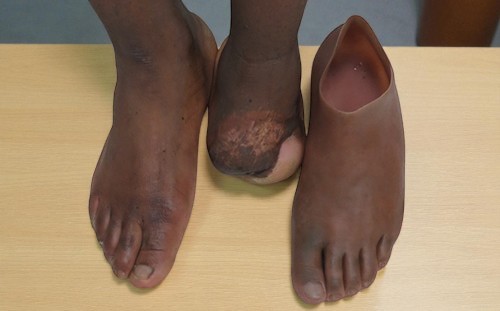
A partial foot prosthesis is a custom artificial limb designed to restore mobility, balance, and comfort after a partial foot amputation. Depending on the amputation level, prosthetic options include toe fillers, transmetatarsal prosthesis, Lisfranc prosthesis, Chopart prosthesis, Syme prosthesis, and ankle disarticulation prosthesis. Made with advanced materials like silicone, carbon fiber, EVA, and pelite, these prostheses provide stability, natural gait, and patient comfort.
Each partial foot prosthesis is tailored with a custom socket, foot component, and suspension system to ensure proper fit, shock absorption, and energy return. With the guidance of a certified prosthetist, patients receive personalized solutions that support walking, standing, and daily activities. Regular rehabilitation and follow-up care ensure long-term comfort, durability, and functionality.
Genu varum (bowlegs) and genu valgum (knock-knees) are common knee deformities in children that often resolve naturally as they grow.
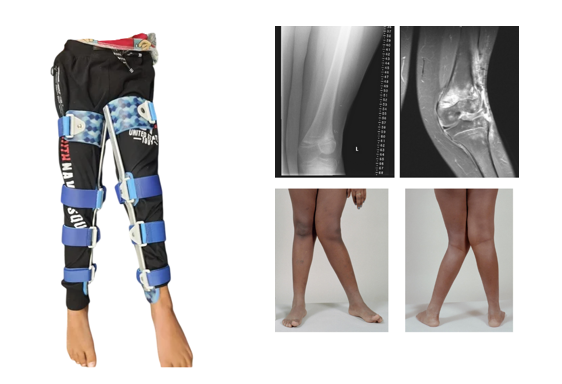
Genu Varum (Bowlegs): In this condition, the knees are apart while the feet and ankles are together, creating an outward curve. It’s typical in infants and toddlers (1-3 years old) and usually improves by age 3 or 4. If severe or persistent, orthotics or braces may be used to support proper alignment and guide bone growth.
Genu Valgum (Knock-Knees): Here, the knees touch but the feet are apart. It is common in children aged 3-5 and typically corrects itself over time. If it persists, orthotics or braces may be used to improve alignment.
Orthotics and Braces: Orthotics are shoe inserts that correct foot misalignment, potentially improving knee positioning. Braces or splints may be used in severe cases to guide proper bone growth.
Braces: In more severe cases of genu varum or genu valgum, braces or splints might be used to help guide the bones to grow in the correct position. These devices are typically used when there's a concern about the condition not self-correcting over time. Braces may be worn during activities to promote proper alignment during movement.