
EVOLUTION HEALTHCARE PRIVATE LIMITE
AMPUTATION LEVEL
Introduction
Amputation is defined as surgical removal or loss of body part such as arms or limbs in part or full. It is usually distinguished from disarticulation where a part is removed through a joint.
Prevalence
One million limb amputations are reported globally each year. And as of 2017, 57.7 million people across the globe have been living with traumatic amputation. Every 30 seconds a lower limb is lost due to diabetes globally. In India, about 1 lakh leg amputations occur every year due to diabetes-related problems, reports the Vascular Society of India. Of the 62 million diabetics in the country, 25 per cent develop sores, ulcers and life-threatening infections on their feet at some point during their lifetime. And also, as of April 2021, United States has over 2 million Americans living with amputation, and another 28 million at a risk of surgical amputation due to underlying causes.
Data from many Healthcare organisation shows 49% rise in total number of amputations during the time of COVID-19 pandemic, during March 2020 to February 2021.
Causes of Amputations
There are several conditions that can lead to amputation.
• Severe infection with extensive tissue damage
• Gangrene
• Trauma resulting from accident or injury, such as crush or blast wound
• Congenital/ Paediatric limb deficiency undergoing conversion amputation
• Congenital deformities of digits or limbs
• Congenital extra digits or limbs
• Necrosis or Necrotizing Fasciitis
• Cellulitis
• Peripheral Arterial Disease
• Frostbite
• Malignant/ cancerous tumor in bone or muscle of the limb e.g. Osteosarcoma
• Conditions that affect blood flow for example Diabetes
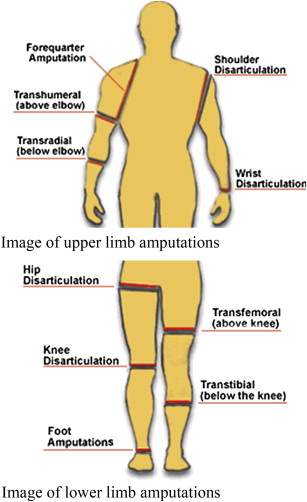
Levels of Amputation
Upper Limb amputation Level
1) Shoulder Disarticulation (SD)
2) Transhumeral (Above Elbow AE)
3) Elbow Disarticulation (ED)
4) Transradial (Below Elbow BE)
5) Hand/ Wrist Disarticulation
6) Transcarpal (Partial Hand PH)
7) Transmetacarpal
Forequarter amputation- In this type of amputation, scapula, lateral 2/3rd of clavicle and whole of upper limb are removed.
Shoulder disarticulation- Removal through shoulder joint. Disarticulation is generally not so popular in the upper limb except at shoulder. Even in disarticulation of the shoulder, the head of humerus is preserved wherever possible to maintain the contour of the shoulder for cosmosis.
Above elbow amputation- Amputation above elbow through the arm.
Elbow disarticulation- Removal through elbow joint
Below elbow amputation- Amputation through the forearm bones
Wrist disarticulation- Amputation through radiocarpal joint
Ray amputation- Removal of a finger with respective metacarpal from carpo-metacarpal joint
Krukenburg's amputation- This is a below elbow amputation done usually on both sides. The forearm is split between radius and ulna. This can be used as a fork and it provides a pincer grip. Making 'forceps' with two forearm bones amputation
Lower Limb
• Hemicorporectomy
• Hemipelvectomy/ Hindquarter amputation
• Hip Disarticulation
• Short transfemoral(above knee)
• Transfemoral (above Knee)
• Long transfemoral (above knee)
• Knee Disarticulation
• Short transtibial (below knee)
• Transtibial (below knee)
• Long transtibial (below knee)
• Ankle Disarticulation (Symes)
• Tansmetatarsal
• Partial Foot/ray resection
• Toe disarticulation
• Partial Toe
Lisfranc's amputation- Through inter-tarsal joints amputation
Chopart's amputation- Through talo-navicular joint amputation
Syme’s amputation- Amputation through the ankle joint. Intact skin over the heel is attached back to the end of the stump with or without a part of calcaneum. Because of the intact heel, it becomes an end bearing stump and the patients generally manage very well walking even bare foot after this type of amputation
Below knee amputation-Most commonly performed amputation, severe trauma to foot and leg. Amputation is performed through the leg bones
Knee disarticulation- Amputation through the knee
Above knee amputation- Amputation through the femur
Hip disarticulation-Amputation through the hip joint
Hind quarter amputation- In this amputation, part of the pelvis is removed along with lower extremity.
Pre-Surgical Evaluation
1. General system review- Cardiovascular & Respiratory[1]
2. Nutritional status
3. Diabetes Control if appropriate
4. Bowel & Bladder Function
5. Past medical history
6. Social history
7. Pre-morbid mobility
8. Strength & Condition of Healthy limb
9. Psychological assessment to access emotion impact of amputation
10. Home & work place assessment to make sure, everything is in accordance for patients maximal self reliance
11. Explanation of post-operative regimen.
Surgery for Amputation
Anesthesia is the first step to any surgery. During amputation, choice of anesthesia depends on the type of amputation, described above on levels of amputation. Two option of anesthesia for amputation are general anesthesia or epidural anesthesia.
While performing amputation